



Martha’s Vineyard Regional High School (MVRHS) opened its doors in September 1959. Since then, the majority of MVRHS graduates who have returned to the hallways of this labyrinthine building have done so to attend basketball games, performances at the PAC, or parent–teacher conferences.
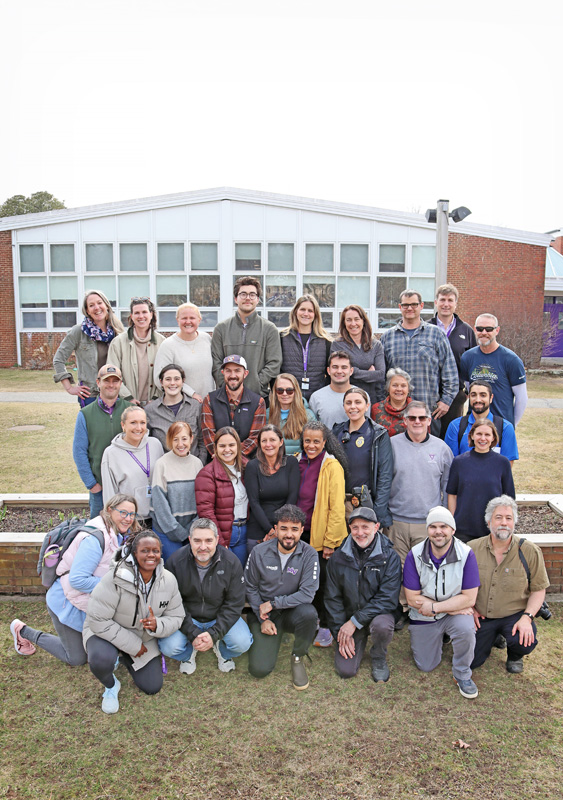
But there are exceptions: those who made their way back to the Vineyard to pay it forward by working at MVRHS. Ranging in age from 24 to 64, there are currently more than 30 of them, a remarkable number for a midsize high school. Their cohort includes guidance counselors, coaches, teachers of science, music, business, nursing, and English. They’re not a homogeneous group, but what they do share matters: a commitment to their vocation and a clear appreciation of what the Island community offers them and their students.
In honor of Teacher Appreciation Week, The Times met with a dozen of these returnees to hear what inspired each of them to teach in the very building where they themselves had spent so many adolescent hours. Community is intrinsic here: Every person in the room had been somebody else’s teacher, or student, or schoolmate (including this reporter). There is a recurrent theme of coming full circle.
For some, the move back was intentional: They knew this was home. Take Justine DeOliveira (class of ’01), who returned to teach Spanish and is now the assistant principal. “I’m a rare case of knowing what I wanted to do: Come back and start a family. But what surprised me is that I came back so soon,” she says. “My first position was covering a maternity leave before I’d even finished college.”
Sheila McHugh Hazell (’13), guidance counselor, has a similar arc: “I always had it in the back of my mind, ‘Maybe one day,’ but it never felt real — and then all of a sudden, I’m here. It felt like a lucky accident.”
Galen Brown (’04), who’d transferred to boarding school, knew she wanted to work and teach here. After a long and winding path, she became an English teacher. She doubted she could live here because of the housing shortage, but then a full-time teaching position became available. Biology teacher Mike Joyce (’86) hadn’t thought of teaching here. One year when he was home for spring break, he recalls, “I’m laying sod at Farm Neck and run into [English teacher] Doug Herr, who said, ‘We’re going to have a science opening, just put your name in and see what happens’ — and that was 28 years ago.”
Rachel Shubert (’08) had just finished grad school at Brandeis and started the job search in Boston, when “I got a call from Shark [Dan Sharkovitz, then English department chair] — I don’t know how he even knew I was job searching. I’d graduated in June, and started in August.”
Haley Hewson (’12) says, “I knew that I wanted to be a teacher when I was 8. When I graduated, I headed to the big city, and I hated it. No matter where I went, it didn’t feel like home. I crash-landed back here, but had so many people to catch me: I was looking for home, and it ended up being exactly where I left it.”
Melinda Canha McCarron (’88), a nurse who teaches health assisting, arrived with a very different story: “I swore I would never come back to this high school,” she says. “Then I had a younger child who was always in the principal’s office — so I swore a second time I wouldn’t set foot in here again. But I was already doing so much teaching in my job [as a nurse] that I thought maybe I could do the same kind of program for the students, and I applied not knowing if I’d like it — and I love it. I’m really proud and happy with the progress the vocational department has made.”
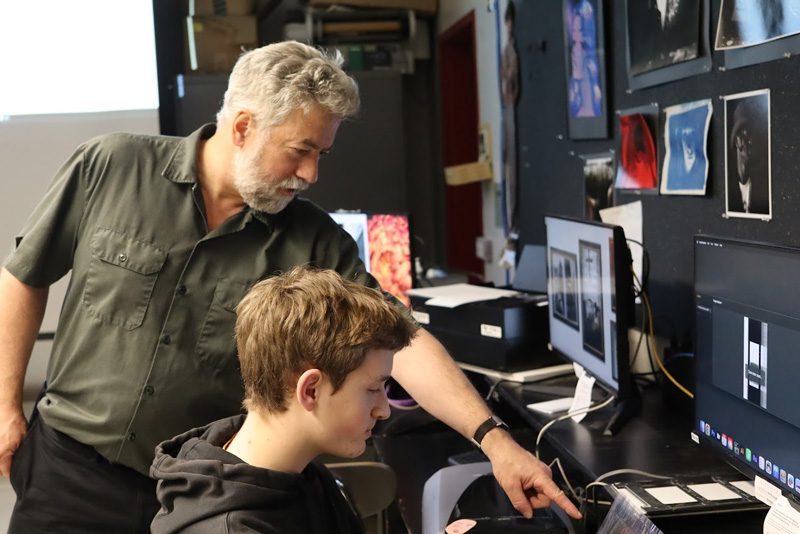
“I was sort of hired by accident,” says Chris Baer (’85). He had been turned down for a position teaching math, and then accepted a job offer off-Island: “I was packed to go, but another position opened up, and even though I hadn’t applied for that one, my earlier application was still on file, and the principal called to offer me the job. I decided to change plans, literally last-minute.” He was hired in technology at first, but now leads the photography and graphics department.
Some of the cohort never expected to teach at all. Here again, fellow Vineyarders get credit for coaxing their return. Music teacher Abigail Chandler (’93) moved to New York City after grad school to be an opera singer. “That lasted about six months,” she says. “I didn’t like it there, and I came home just to regroup. I came to the high school for an event, and Janis Wightman [then the Minnesingers director] said, ‘You should think about getting your certification to teach,’ … and I did. And now I can’t imagine living anywhere else, even though I backed into it.” Coming full circle, Chandler herself now directs the Minnesingers.
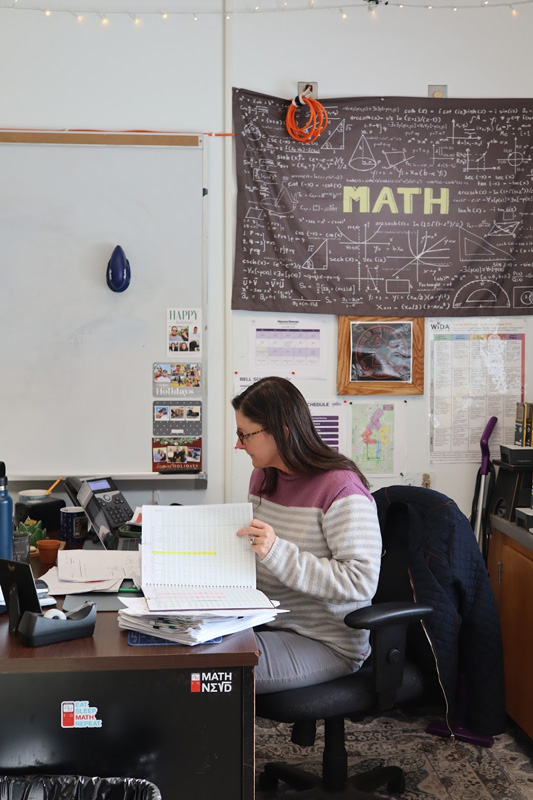
Math teacher Carole Flanders (’90) had an entire life off-Island with no plan to return, until she married an on-Island Islander, and after three years of a long-distance marriage, took a position at MVRHS so they could be together. Nell Coogan (’97) enjoyed her life as a lawyer working at the State House in Boston, until she met her on-Island future husband, returned to be with him, and found her calling as a guidance counselor.
Mark McCarthy (’79) is the eldest of those in the room. His is a tale of two spouses: He came back in 1988 to be the athletic director, but left because his wife didn’t like it here; after more than 20 years in Connecticut, he was seeking a change in profession, and his new wife was happy to come. Director of Operations Sam Hart (’95) knew the superintendent and the principal when he was hired to work on, among other things, the school building project. He’d never planned on living here as an adult, but while visiting, he met the woman he would later marry.
Jack Pacheco joined the faculty most recently, in January 2025. “I had a wonderful high school experience — thanks to the majority of the people in this room,” he says, “but it was cut short on March 13, 2020 [by COVID].” At loose ends after business school, he took a sub position in the math department here, before being hired as a business teacher. “The same principal who shook my hand as I was walking across the stage to accept my diploma shook my hand when I took my first big job,” he recalls.
Around the room, people nod and say, with smiles, “Same.”
Of course, returning to such familiar terrain is not uncomplicated. Greeting by first name elders you’re used to addressing as teachers was an uncomfortable adjustment for some. “It was hard, coming back and seeing my old teachers now as colleagues,” says Baer. “You were a high school teenager; it’s embarrassing to remember all the stupid stuff you did, and facing all these people you did it in front of.” Around the room, people make faces of acknowledgement, sometimes accompanied by sheepish laughter or an exchange of knowing glances.
But from a pedagogical perspective, teaching where you learned gives you an insider’s insight of the school population and its needs. “I hope that with the support of the people in this building, everyone here can be helped to find their way through whatever they are going through,” says Hazell.
Hewson observes, “We’re rural, so a lot of kids know they are not going to college before they even enter.”
To which Coogan adds, “One of my favorite things is people find their niche. Not every kid, but so many find it, figure it out, and know that they have people here who care about them. There’s just so much support.”
“I second that,” says DeOliveira. “It’s one of the most special things — the students’ ability to engage and find their place — and for the staff to have their passion and to share it with students.”
So generally, collective history is a positive thing, and everyone is quick to share their appreciation for their role models. Many names are referenced. Certain ones come up a lot. Across the broadest age range, Coach Jay Schofield (“Scho” to many) is beloved. He was not only a long-term gym teacher and coach of several sports, but a role model for positivity; DeOliveira remembers his teaching the girls’ varsity soccer team how to change a tire.
The late math teacher Lou Toscano is another icon; he inspired both Baer and Flanders to become math teachers. In yet another touching example of coming full circle, Flanders — chair of the department Toscano chaired when she was his student — now selects which student receives the Louis Toscano Memorial Scholarship.
Music teacher and girls’ basketball coach Bob Nute also elicits gratitude, especially from Chandler, who pays it forward: “Bob Nute is the reason I graduated high school, so I now get to spend my life creating that space for my students.” Other names spill out as these MVRHS teachers honor the MVRHS teachers who inspired them: Dianne McDonough, Corrine Kurtz, David Wilson, and many others, all remembered with admiring anecdotes.
McCarthy points out, “I think we all remember key teachers who taught us here, and each and every one of us aspires to be that person … I just hope that in 25 years, there are people sitting in this room who say the same thing about us.”
His saying “us” instead of “me” reflects the zeitgeist of the school. The high school has always emphasized widening the welcome, creating opportunities for a huge variety of interests and personalities.
Joyce recalls, “When I was in high school, in the ’80s, it was much smaller, but still you got an opportunity to do everything. My day was full — with sports, band, chorus. And that hasn’t changed. There are a million people at sports events; people come out for the kids, and support them every way they can.”
“I think we all are saying the same things,” Chris Baer observes. “The things we remember are not the things you learned in Chapter 7, but the things you learned in community.”