

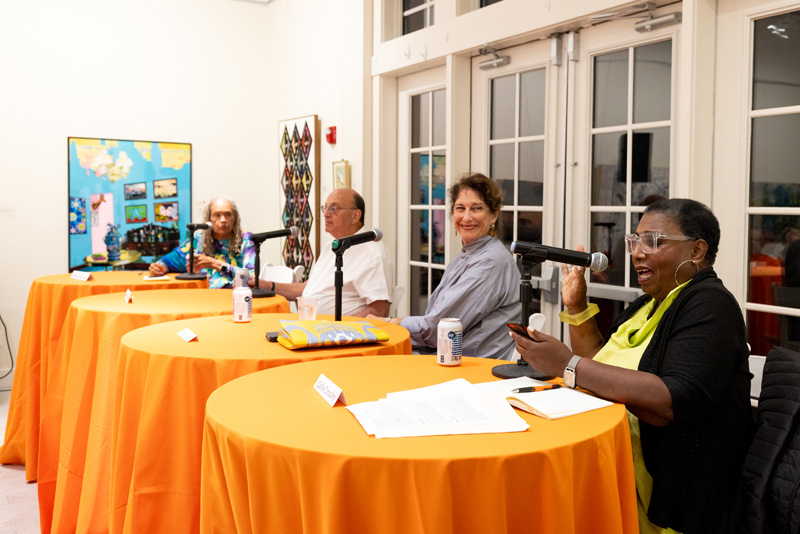

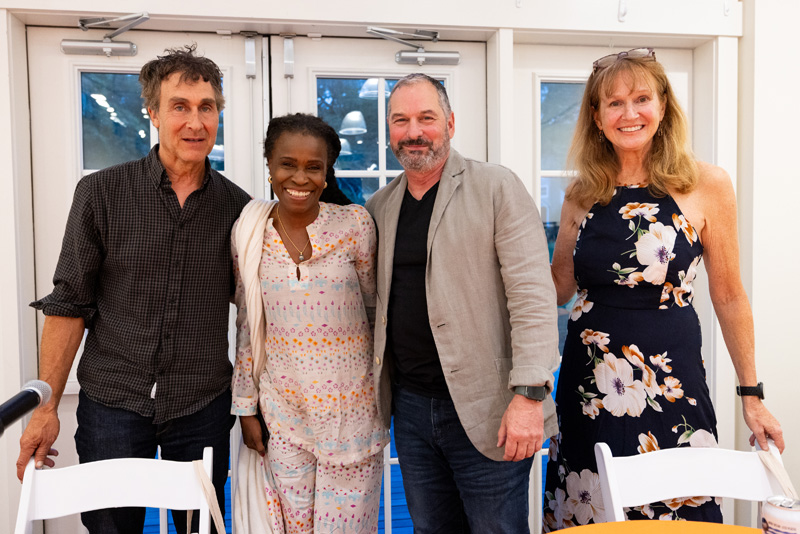
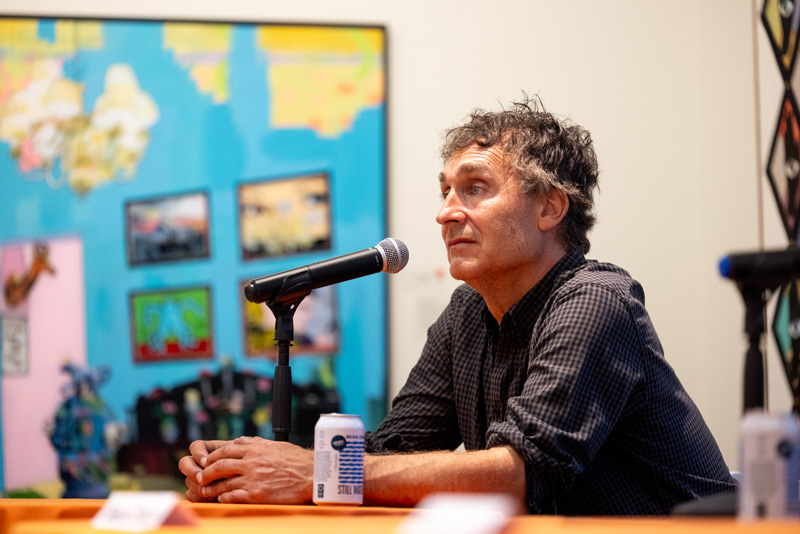
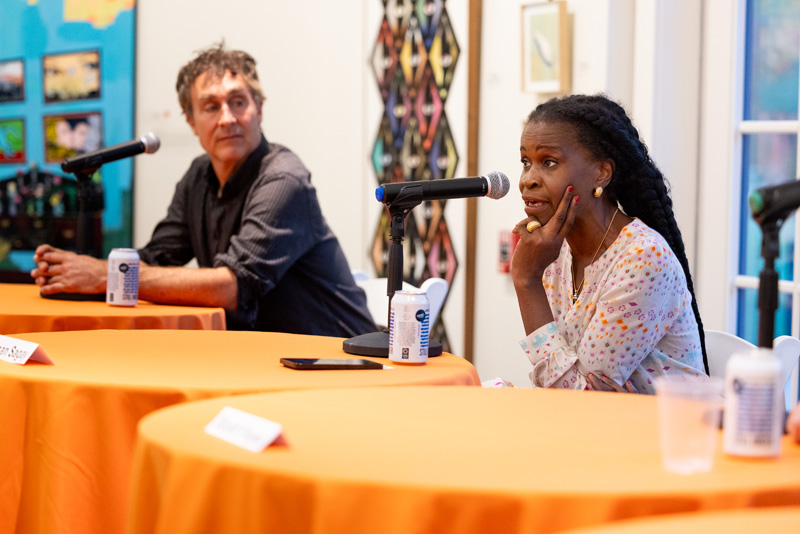
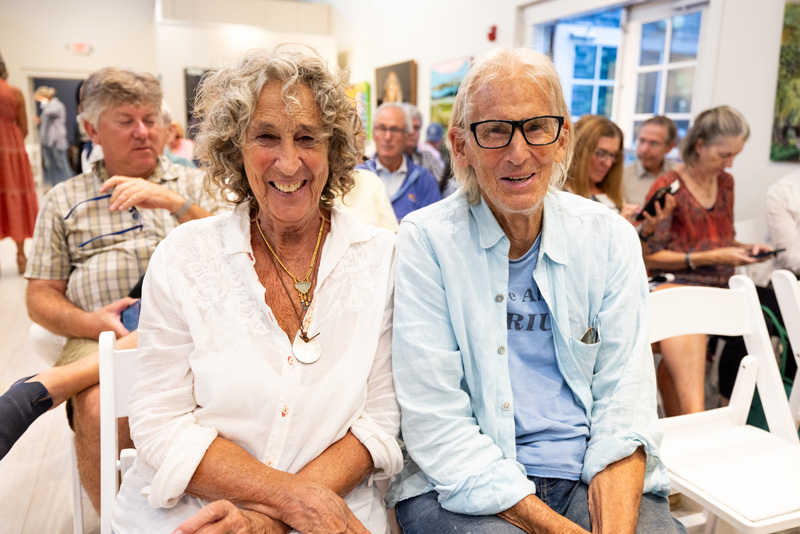
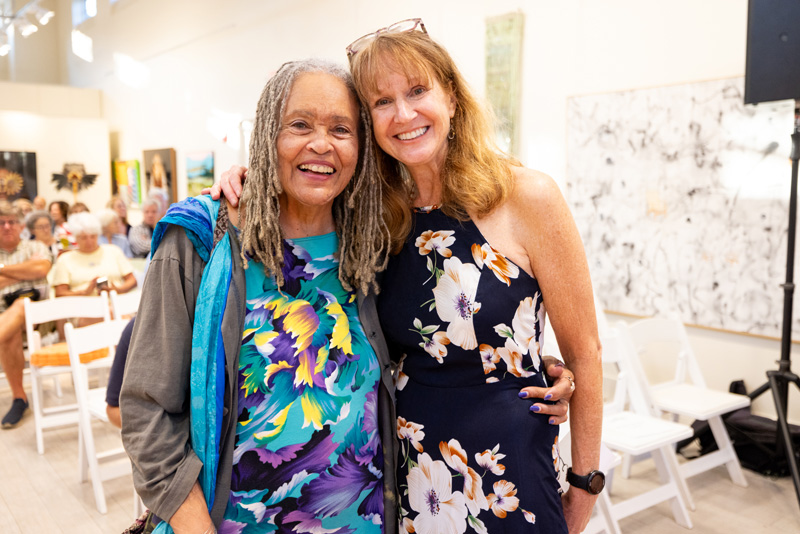
Opening night of Islanders Write, held at Featherstone Center for the Arts in Oak Bluffs, delved into issues that have been top of mind for writers nationwide: fair compensation, the complications of artificial intelligence, and how to cover the Trump presidency and campaign.
Started in 2014, The Times and the MV Arts & Ideas Magazine hosted the two-day, free event, bringing Islanders and visitors together with a shared interest in writing.
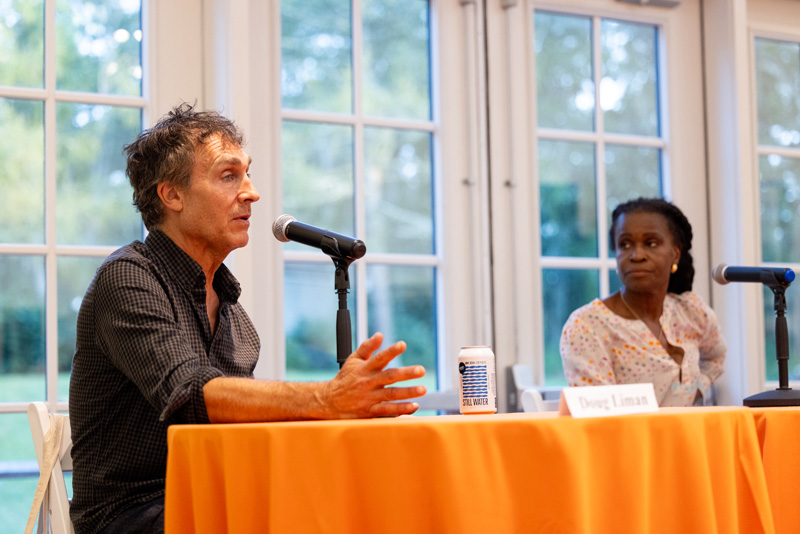
The first panel on Sunday evening, “Writers on Strike: What’s Happening in Hollywood?” looked at issues surrounding the Writers Guild of America, whose members went on strike on May 1.
Kate Feiffer, Islanders Write producer, opened with an excerpt from a recent Los Angeles Times article, which indicated that while initially entrenched, the networks and streaming services were now motivated to come to an agreement. Turning to the panelists, she asked, “So, where do we stand?”
Scott Frank, co-creator, executive producer, and director of the Netflix series “The Queen’s Gambit,” shared that this strike differs from others he experienced previously because the actors are on strike, too.
“The Guild can be a nuisance, but it can’t shut down the industry the way the actors can,” he said. “If it goes on much longer than a month from now, they lose summer movie season, which leads to mutually assured destruction. I think it’s complicated, and people don’t know what the future will look like. And it’s difficult to create a deal around that, but I think they are both motivated to figure it out by October, or both sides are in trouble.”
The conversation was complex and touched on many issues, just one of which was whether there should be a quota for how many writers work on a show.
Doug Liman, an American film director and producer known for directing the films “Swingers,” “The Bourne Identity,” and “Mr. & Mrs. Smith,” believed that having a group of writers in a room collaborating with the creative juices flowing was beneficial.
In contrast, Frank, who was the only writer for “The Queen’s Gambit,” thought otherwise.
Misan Sagay, a British-Nigerian screenwriter best known for the film “Belle,” shared the importance of writers’ rooms as a training ground for young writers.
Liman brought up another hot topic, asking the others if they thought AI, rather than taking jobs away, would be more likely to be used as a tool by writers. It could be used to help start a writing project, for example. Sagay agreed that it will change how writers work. But for her, she wouldn’t use AI to write a first draft; keeping her voice was important. “But I can imagine I would be interested in its rewrite, and a computer working with a writer,” she added.
Liman couldn’t imagine not having a writer writing the script, but he said that there will be impacts from AI. “… extras working in movies, their days are numbered,” Liman said. He cited his use of generating extras in crowd scenes.
Frank also brought up another challenge, which is about compensation. Writers in network television get paid residuals and for syndication. But now, Frank said, “If you sell a show to a streaming service, they are not reselling it. You get paid once rather than paid every time someone watches it.”
Furthermore, with services like Disney Plus, Amazon, and Apple TV, the single pay or “buyout” is not a lot of money. “We need a rule for everybody, but streaming services have different agendas,” Frank said.
“We are really stepping into a different time where the models of how writers work are going to change, and we’re going to have to find a way to that future,” Sagay said. “We want to preserve as many jobs as possible…and make sure members will be able to make a living.”
The second panel, “Equal Time, No Time, or All the Time: Politics and the Press,” was a conversation moderated by Callie Crossley, host of WGBH’s “Under the Radar with Callie Crossley” and weekly contributor to the station’s “Morning Edition.”
Crossley set the conversation in the context that the word “unprecedented” has become standard during the last few years, as the former president is preparing to defend himself against criminal charges, while no law says he can’t serve if convicted and in jail.
Crossley continued that a Reuters poll last month stated that 42 percent of Americans avoid the news at least some of the time because it grinds them down, and they don’t believe it. Fifteen percent disconnect all the time, and the self-identified on the right say the news is biased. Those on the left are overwhelmed and have feelings of powerlessness or worry that news might create arguments. Given this, she posed, “How did we get here?”
Walter Shapiro—an award-winning journalist and a staff writer at The New Republic, a lecturer in political science at Yale, and a White House speechwriter for Jimmy Carter, said, “We talk a lot about income inequality, but we should also be talking about information inequality. On the one hand, we are awash in information, but too many people either don’t care or can’t find it.”
Mara Liasson, whose very first job was with the Vineyard Gazette, is a national political correspondent for NPR, heard regularly on Morning Edition and All Things Considered, put forth, “So many things led us to where we either don’t consume news, or we can’t escape from the news. All the forces of modern life have polarized us. We don’t watch three network anchors anymore, and it was a lot easier to build a civil society when we started from the same set of facts and worked our way to different opinions. Now we start with our opinions and cherry-pick our facts. Not only is news completely fractured, but people also look to news media for affirmation.”
Charlayne Hunter-Gault, an American civil rights activist, journalist, and former foreign correspondent for National Public Radio, CNN, and PBS, made several points, including that there is a lot of confusion about where to get good news these days.
“How do you make a determination about what is good information? How do we inform people intergenerationally, and what mechanisms do we use to do that?” she asked, mentioning our overwhelming number of choices.
Crossley also posed the question: How do we ensure that not all coverage is about President Trump? Liasson pointed out that the news media got things wrong with Trump and the endless reporting of everything he said and did. But now — given January 6 and the federal and state indictments Trump is facing — covering the former president this election is, she says, “About American democracy.”
“This isn’t just about some crazy, outrageous celebrity TV guy who wants to be president. I think it’s going to be something much bigger,” she said. “It’s not going to be about policy, but it will be about what it means to have someone return to office who doesn’t believe in democratic institutions.”
There was much more to the wide-ranging discussion, including the media’s focus on President Biden’s age and potential impact of Hunter Biden, as well as the importance of local journalism and the raid of the Marion County Record — a weekly newspaper in Kansas — and its relationship to the First Amendment.
Interestingly, Crossley shared that when she asked people in a self-proclaimed, non-scientific poll what bothered them most about political coverage, it was speculation. Shapiro responded, “The truth is we don’t know what is going to happen. We are treating national polls six months in advance as though they have been handed down from Mount Sinai. My big hobbyhorse is—more humility, less false certainty.” Liasson added, in reporting on politics, “Every day we wake up to find that what we thought was going to happen was wrong.”